
Only a few months after the core set came out, FFG dropped the Dunwich Legacy deluxe expansion—an additional that, with the rest of the Dunwich cycle, was really meant to round out the base set (which might be a problem in the “current” format, unless the Arkham Horror development team thinks the Starter Decks serve a similar function . . . which, yeah, they mostly do).
As for the Deluxe Expansion, most of the cards are meant to support the Dunwich investigators out of the gate. Whether this alone moves the needle on any of them is pretty unclear, but after a thorough dive: . . . probably not.

GUARDIAN
Blackjack (Dunwich Legacy, #16)
Brief: a cheap weapon that solves a problem that doesn’t really exist
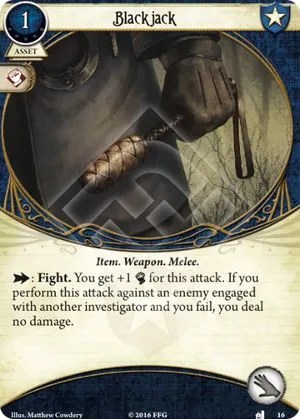
Blackjack makes some sense in theory: it’s a cheap, off-hand weapon that adds a minimal boost and chip damage, in a class that struggles for resources. What’s super weird is that it came out alongside Taunt and Taunt (2), events that engage enemies for free . . . which is something Zoey, the Dunwich guardian, wants to do. Is there an investigator who wants an off-hand weapon and benefits from negating the accidental point of damage?
Best in-class fits: Roland, Mary
The best-case scenario for Blackjack is probably in a hard flex investigator with decent combat, someone unlikely to do much fighting in a three-person team but able to chip some damage here and there. The only reason to take it, and not Knife, is for that second ability. Roland fits weirdly well? Fighting at a combat 5 is far from certain, and he might be building into his seeker sub-class (this is far from optional, mind). Mary might be playing pure support; it’s not great in her, but probably safer than alternative fighting options.
Best out-class fits: Skids, Jim, Diana
Is this a Jim card? It puts him at a combat of 4, he’s probably playing support or flex in parties of three or more players, and testing at even because of his power. He’s a much better call than the other two, who are mainly here for their ability to flex; as spell-casters, he and Diana don’t care as much about hand slots, either.
Taunt (Dunwich Legacy #17)
Brief: some limited action compression in a class that could use it
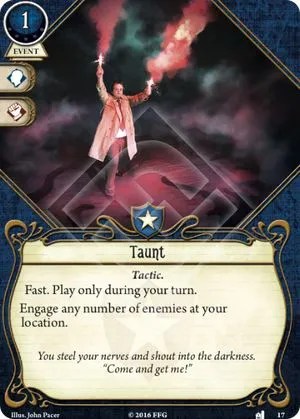
A limited extra action, kind of, which will probably go off at some point. It’s worth mentioning that action compression is often more valuable in enemy handlers, who often benefit from killing things fast (most obviously by preventing damage and horror, but often other effects as well). This is especially true for aloof enemies, which are more common than expected. In other words: enough applications to make sense in anyone expected to be killing enemies, especially in larger player counts, but not the flashiest card.
Best in-class fits: Zoey, Tommy, Marion
Zoey likes engaging things because, well, she’s a guardian with some resource generation, and that’s pretty sick. Mind, this probably isn’t much better for her than, say, for Roland, even though it was clearly printed with her in mind. Tommy and Daniela like this in larger player counts because they don’t mind tanking an entire team’s worth of enemies. It’s probably better in Tommy; Daniela gets a version of this power with her signature.
But really, Marion is the answer here, right? It’s a cheap and fast event that procs Marion’s power, turning any other event into a fast event and drawing her a card. Unreal action compression.
Best out-class fits: Tony
Tony doesn’t hate this. He doesn’t love it, either; it’s slight action compression for an investigator who has lots of routes for the same thing (Quick Thinking costs nothing, for instance, and gives a limitless action on success). But frankly, the investigators that want to tank a bunch of damage and horror are mostly in survivor, and none of the good options have access. Shame.
Teamwork (Dunwich Legacy #18)
Brief: a cool concept that is actually super complicated to pull off effectively
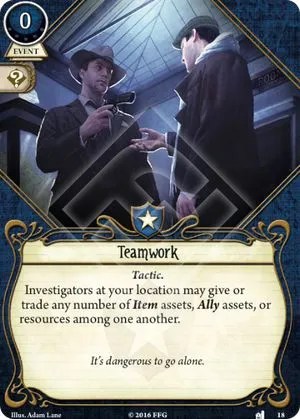
This card rocks in theory. Guardians have cool stats, but are hamstrung by significant resource generation and occasionally, cards that would otherwise go really well with a fighter but ugh Mauser C96 is in rogue, and listen there’s a Mark deck that fights enemies one location away and it really needs Cat Burglar, what about that isn’t clear? The thing holding Teamwork back is, well, it’s already tough to build a deck with cards that combo with each other in an effective way. Building multiple decks that combo together is daunting at best, and for what? Teamwork?
Best in-class fits: Carolyn, Carson, Marion
Oh man. Is the move to use this as a support guardian? Honestly, in a vacuum, that’s probably the answer—hence, Carolyn and Carson. Carolyn has resource generation but a limited card pool; that said, she could totally support a Hank or Silas. Both would love access to guardian cards. Carson can get them higher-level guardian weapons, too, but he’ll be a little harder-pressed to lean into clue-getting and should probably be reserved for higher player counts. For two-player, Teamwork Carolyn (ha) is probably the play.
But the actual play is Marion, with anyone who can sauce her resources to play for all of her cool events, right?
Best out-class fits: Skids, Joe, Diana
Who is missing something cool with their card p—oh hell there’s an obvious answer isn’t there.
Best upgraded guardian cards Daniela can “take” with Teamwork: Guard Dog (2), Martyr’s Vambrace (3), Shield of Faith (2), Hunter’s Armor (with Hallowed and Armor of Thorns)
These all seem built for Daniela, maybe excepting Martyr’s Vambrace, which would simply go hard in a mythos-breaking Daniela build where she takes literally every card from the encounter deck and deals with it. The rest are obvious: Guard Dog (2) procs Daniela’s ability and returns damage; Shield of Faith cancels up to five enemy attacks, but not return damage; and Hunter’s Armor gives Daniela sanity soak and additional shots of return damage.
You know who can take most of these cards? And get clues? Let’s go with all the second-class guardian except Yorick, whose role and card pool overlap a little too much with Daniela.
Taunt (2) (Dunwich Legacy #19)
Brief: more power, but the XP cost (and significantly better level-3 option) limit its use

This adds card draw for each enemy you engage, which can be powerful. For Zoey especially, it’s a card and a resource, which really starts to sound good . . . until you discover there’s a level three version that also deals free damage to every enemy, which is just way better. That one also comes with some niche play flexibility, so tragically, the level-2 version is best reserved for investigators who want to tank, but only get guardian cards 0-2. That’s pretty much no one.
It does work with Down the Rabbit Hole and Stick to the Plan, however. Those are both relevant, especially the first, which means you can effectively upgrade this to its level-3 version over two scenarios for only 1XP. That’s not terrible.
Best in-class fits: Zoey, Tommy, Marion
Who struggles with card draw? No one with access to rogue or seeker, really; both have high-value card-draw engines, even at lower levels. Even survivor has decent card-draw options. The best bet here is probably guardian or mystic, so let’s go with . . . Sister Mary? Running Shield of Faith?
Ugh, no, it’s probably just these three again. A special shout to Nathaniel, too, who gets a fair bit of mileage out of that bonus card draw.
Best out-class fits: Diana, Lily
Okay, that’s slightly more interesting. Both like card draw, both can take Down the Rabbit Hole, and Lily can even run this in Stick to the Plan. The drawback of “engage everything” is typically the damage and horror that comes from . . . engaging everything . . . but if you can kill them first, with some combination of multiple-fight effects (Butterfly Swords, One-Two Punch, Flurry of Blows, or Discipline: Balance of Body), that concern becomes trivial.
That probably makes Lily the ideal target for Taunt (2), but Diana certainly doesn’t mind the card draw as a largely event-based mystic, and can always Ethereal Form her way out of trouble as needed.

SEEKER
Laboratory Assistant (Dunwich Legacy #20)
Brief: a shocking mainstay for her effect in big-hand decks, with a surprisingly potent effect

There are a few seeker-ally-event cards, but none empower an archetype as well as Laboratory Assistant, who somehow has three relevant effects that all play well together. If the goal is to keep 8-10 cards in hand, this not only draws up, but also increases the hand limit, and also provides soak for deck cycling. She also plays into the Miskatonic Army playstyle, which is a bit weirder and less potent, but worth mentioning.
Best in-class fits: Minh, Mandy, Harvey
Not a surprise. Card draw is generically good, but these three get added benefit due to their ability to run the big hand archetype. Harvey might actually be the worst of the three, or at least, the most stressful due to his weakness (which isn’t prevented by this). That’s not to say Lab Assistant is bad in other seekers, but she does get a lot less potent.
Best out-class fits: Luke
There isn’t a big-hand Jack build that includes this and Forbidden Tome (Secrets Revealed), right? Is there? The card draw is at least slightly appealing to Luke, but the soak isn’t. Maybe this isn’t that good for him, either, when he could just run Preposterous Sketches and be done with it.
Strange Solution (Unidentified) (Dunwich Legacy #21)
Brief: a relatively easy research card with some totally fine upgrade options
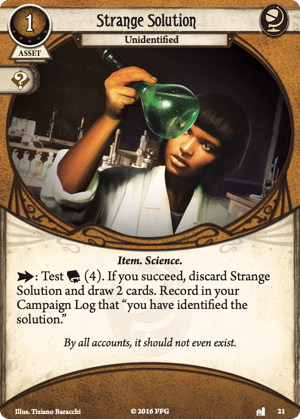
Compare this to Cryptic Grimoire, which requires the team to stack the chaos bag with ten curses. Or Forbidden Tome, which requires 10 or more cards in hand and six actions (five, which draw one card apiece), without secret-moving shenanigans. This one is two actions, one resource, zero slots, and nets two cards in the process. All the investigator needs to do is pass a basic little 4-intellect test. A quick look at the upgrades:
- Acidic Ichor: (3 supplies). For an action, attack with a combat-6, for three damage (tabooed to two).
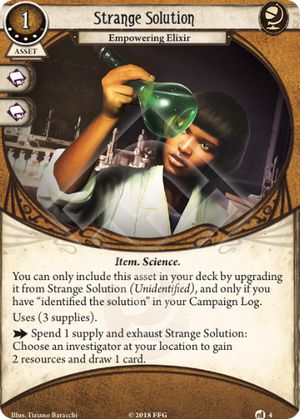
- Empowering Elixir: (3 supplies). For an action, turn each supply into two cards and a resource for an investigator at your location.
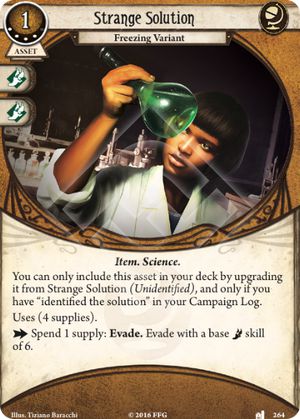
- Freezing Variant: (4 supplies). For an action, evade with an agility-6.
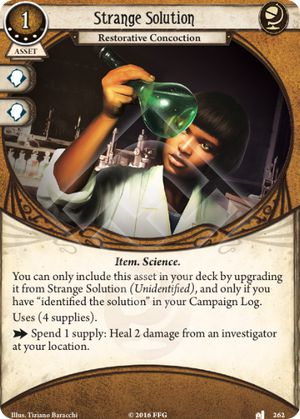
- Restorative Concoction (4 supplies). For an action, heal two damage from an investigator at your location.
There will be time to get into each of these cards in detail as they come up, so instead, a quick breakdown: there is zero balance here. The Ichor has always been the strongest, allowing seekers to match early guardian firepower. It’s a totally valid target for Emergency Cache (3), which adds four supply tokens to any card; with both, seekers can fight with a base-6 combat, seven times, dealing a maximum of 21 damage. Remember how Amanda can take Vicious Blow?

The rest are mostly support, but are slightly too limited to be considered for most decks. They especially look bad beside Easy Mark, which nets a (slightly worse) single card and two resources, but only costs a third of an XP; and Alchemical Distillation, which at baseline draws two cards, and at 4XP, can come into play with 5 supplies (Refined), include the damage healing (Mending Distillate), and allows two options out of cards, resources, or healing on over-success (Perfected).
That’s not to say Strange Solution is bad. It’s relatively easy to upgrade, after all, is dirt cheap, and doesn’t take up a slot. But at this point it’s not exactly a build-around, and do you really want to spend 8XP for that?
As a final note, it is one of the best targets for Shrewd Analysis, because none of the upgrades are strictly unplayable, and they all feel much better for 2XP.
Shortcut (Dunwich Legacy #22)
Brief: a free, zero-resource action with a high floor and a somewhat low ceiling
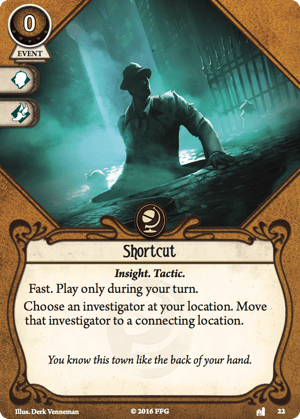
Simply a good card for action compression. The nuance comes from a few tiny details: it allows any investigator at the same location to move, it doesn’t provoke attacks of opportunity, and it has the tactic trait. That makes this shockingly versatile, especially for AOE card effects that damage other investigators (Dynamite Blast, Storm of Spirits). All that to say: Shortcut is a legitimately potent seeker support card. Or just a free action.
Best in-class Most interesting fits: Mark, Luke, Trish
The obvious answers would be “Ursula and Monty” because movement gets their investigator abilities online, but these three simply have more interesting use cases. Mark, or really, any guardian with seeker access, can take this as a clever way to proc Safeguard, moving a different investigator away from your location and then doubling up their movement. It’s a neat little combo that feels nice to pull off, and can be done very easily.
What Mark doesn’t get is access to Double Double, which doubles the range of Shortcut—something Trish can do. But the reason she takes this is to drag enemies to locations with clues for general Trish shenanigans, without provoking an attack of opportunity. There are other ways to get a similar result, but none that cost so little. And then there’s Luke, who can use this to give anyone at connecting locations a free bit of off-turn movement, something that comes in handy more often than expected.
Seeking Answers (Dunwich Legacy #23)
Brief: a surprisingly versatile card that doesn’t get the credit it deserves
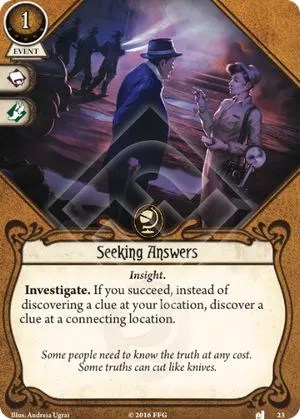
There isn’t often a lot of love for Seeking Answers, a card with ho-hum icons and zero obvious tempo. That said: for a level 0 card, it solves a lot of problems. The most obvious for basic investigators are:
- one location has a high shroud value, but the one beside it is much easier to investigate;
- a location can’t be investigated, but the location beside it can; and
- there’s a good reason to leave a VP location, but there’s still a clue there
If those situations sound familiar, that’s because some version of them happens in pretty much every scenario. And while there are surely other ways to deal with those problems, Seeking Answers has a sneaky bonus: no one expects it, and everyone is impressed when it goes off in a satisfying way. And then there are the baller edge cases, such as:
Best in-class fits: Rex, Ursula, Amanda
This card was made for Rex, and it’s a shame he’s not on the art . . . but that’s fine. This enables solo Rex in such a huge way, allowing him to scoop clues from two one-shroud locations on an over-success. It also allows a Deduction play in higher player counts, where Rex gets three clues; two from a connecting location, and one from his. Amanda likes it for similar reasons; on Deduction-enabled, Clue-ver turns, this lets Amanda spread her investigations over multiple locations without moving (Shortcut makes this even better).
Ursula, meanwhile, has the most and lease obvious use cases. Most: it allows her to move away from a location before all the clues there are gathered, making it easier to proc her ability. Least: it gives her permission to use her Elder Sign ability, which triggers so frequently on locations that still have clues. She can even use Seeking Answers as her free investigate action.
Best out-class fits: Monterey, Trish, Luke
Monterey maybe likes this for the same reason as Ursula, but there are simply better options for his limited level 0 seeker splash. Instead, let’s go with Trish—who can double up on adjacent clues, or turn off a hunter enemy for a round—and Luke, who can use this to get clues from anywhere on the map, basically (and investigate at a shroud of 1, if inside Gate Box. Pretty sweet).

ROGUE
Liquid Courage (Dunwich Legacy #24)
Brief: a slot-less rogue asset that oozes flavour, but maybe, is best taken out of class

How many rogues can pass a willpower test of 2? Sefina? Does she count? There’s an argument that losing a card from hand isn’t a big deal, but it’s probably more optimal to run a smoking pipe and trade horror for damage . . . so ideally, this requires an investigator that at least usually gets into that 4-5 willpower range, where most of the bag heals two horror. Oh, and they probably want to be in need of horror healing themselves, or at least, adjacent to someone who is.
Best in-class fits: Jenny, Alessandra
As much as “rogues = bad willpower” is a thing, there are quite a few that have a base of 3: not terrible, not good. Just, average. There’s even a level-0 rogue ally (Dario El-Amin) who gives a willpower boost at 10+ resources. That makes this at least plausible for Jenny and Alessandra, investigators who can run (and make use of) both cards, and both skill boosts. And while Jenny can pull off the resource threshold a little easier, Alessandra can really benefit from that intellect boost, which puts her firmly into seeker territory (Jenny needs a little more help *cough* Well Connected *cough* to be a dedicated investigator).
The most obvious call, though, is probably still Sefina, who starts at a base-4 willpower and doesn’t mind the horror healing, depending on the spells she’s running.
Best out-class fits: Zoey, Carolyn, Dexter
So many investigators can plausibly get value out of this. Wendy and Pete start at an base-4 willpower and have an only-okay sanity pool, but both suffer more than usual from being card-poor. Jim and Dexter don’t mind the horror healing, but start at eight apiece. That said, Dexter likes cheap, disposable assets, so let’s give him a slight nod (this would also cut into Jim’s splash).
The other two spots are more obvious. Carolyn needs something else to boost her willpower (if she wants the bonus healing), but she usually has options for that, and Liquid Courage allows her to actively proc her ability. Taking this in Zoey, meanwhile, adds a neat thematic spin on the character and gives her a way to protect her small-ish sanity pool with her good (4) base willpower.
Think on Your Feet (Dunwich Legacy #25)
Brief: a reaction ability that sounds better in theory than practice
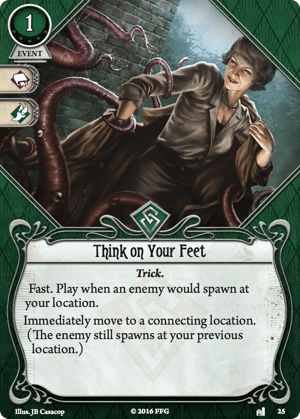
This has much the same reputation as the seeker event Seeking Answers, but its use cases are far more limited: you’re not equipped to handle enemies, an enemy spawns at your location, and for one round (at least) you don’t have to deal with them. There’s a best-case scenario, too, where this also pushes you in the direction you would be going anyway . . . but it’s limited enough to most often stay in-hand, waiting multiple rounds for a viable play.
There’s also a genuine issue with this in rogue (when it’s so obviously a survivor card): most rogues have excellent agility, and rewards for evading enemies, which limits this even more. That said, there are use-cases.
Best in-class fits: Skids, Jenny, Preston
So, all the rogues who can’t (or usually don’t) want to deal with enemies via fighting (Tony, Michael), evasion (Skids, Sefina, Finn, Trish, Monty, Kymani) or dastardly manipulation (Alessandra). That’s everyone, right? Skids at least gets a mention for his access to guardian, which gives him a few tools for fighting at range. Would he ever take Fox Mask (which replenishes via Think on Your Feet) over Wolf Mask? Maybe Skids is the group investigator. Who can say.
This is probably better in Jenny and Preston, who might be leaning into investigation and don’t care about the whole evade-and-profit cycle. For Preston, especially, this solves a problem and bakes in some minor tempo. Let’s end there.
Best out-class fits: Rex, Jim, Mandy
These are also . . . underwhelming. For Rex, at least, it’s pretty thematic and prevents his deck from leaning too hard into agility, when he really prefers the intellect-for-days approach. It does eat into his splash, however. With a low agility, meanwhile, Jim can absolutely be shut down by an unlucky mythos draw. And yet, it eats into his splash too. Basically, when printed, this was a much more valid option.
And then there’s Mandy: someone with so much (potential) card draw, a more generous splash, and just as few ways of dealing with an enemy in the mythos phase. And she’s usually running rogue off-class, too. Not the worst idea, bringing one of these for the road.
Double or Nothing (Dunwich Legacy #26)
Brief: a genuinely game-breaking card that remains pretty fun in normal play
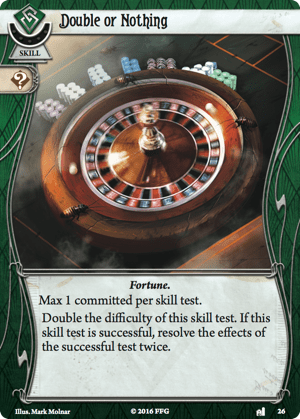
Oh man. They really tried to throw rogue a bone with this one, but even as early as its release, this was crazy powerful. In fact, the developers probably realized that issue immediately and slapped a little asterisk on Rex (no Fortune cards)to prevent him from hoovering six clues in one action, with this and Deduction. Unfortunately, Double or Nothing really limited the design space of the game, so it had to be effectively removed from rotation . . . but at the time, it finally gave early rogue players a powerful payoff for succeed-by-two that wasn’t, like, “the weapon actually works now!”
That is to say: there’s a sad irony that Skids and Jenny have some of the worst stat-lines in the game, so their ability to play this remains a bit sketchy compared to pretty much anyone else. To be honest, it might be best to leave the game breaking “creativity” of Double or Nothing to the comment section on Reddit, and just consider how the phrase “double or nothing” is fully misused in the context of the card mechanic.
Hired Muscle (1) (Dunwich Legacy #27)
Brief: a cool concept for a card, and decent soak, but no obvious synergy
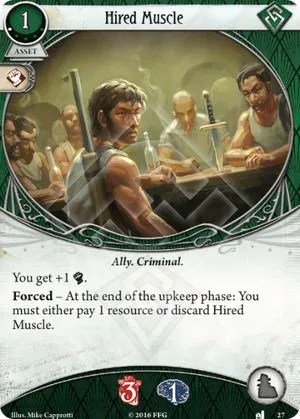
Hired Muscle isn’t Leo de Luca, so that’s already a problem. And he costs XP. But the biggest issue is, well, that effect just doesn’t go away, so unless you’re prepping buddy for a quick void (. . . phrasing?) there’s no reason to play him over, say, Beat Cop, which might actually cost less long-term.
The concept makes sense: Jenny, for instance, can swap her power for a permanent stat boost. But like, what does a base (4) combat get you? Fail by slightly less, bump you into Rabbit’s Foot territory? At time of printing, this dude didn’t make much sense. He makes slightly more now, thankfully.
Best in-class fits: Jenny*
*Does Jenny really like Hired Muscle? She can grab Lonnie Ritter for a one-shot cost, which is probably better value and calls back to her novella (or Robert Castaigne, but there’s zero synergy or full novella tie-in there). Jenny likes the static combat boost; it allows her to fight at a super respectable base-6 with her Twin .45s, which lets her use, say, Well Connected (and other skill-boosting card effects) more selectively. But she can almost as easily take Delilah O’Rourke (3), which buffs her agility too, and gives her the ability to pot-shot enemies without even engaging them.
Best out class-fits: Leo, Dexter
The better fit is probably Leo, who might be running disposable allies and can throw this guy into combat while in combat, without taking an attack of opportunity. At that point, he becomes free cannon fodder. That’s probably the admittedly underwhelming play.
Is there a Dexter play here, though? He also gets a free discount and play action, but it’s a slightly awkward fit; either Dex is playing Hired Muscle for the combat boost, which maybe pairs with, uh, Spirit Athame? . . . but the soak doesn’t really work with Dexter’s wacky asset mill, because the ideal play is to have this guy around to discard him for something better. Not ideal.

MYSTIC
Rite of Seeking (Dunwich Legacy #28)
Brief: a crucial piece of mystic clue tech, with a brutal weakness worth playing around
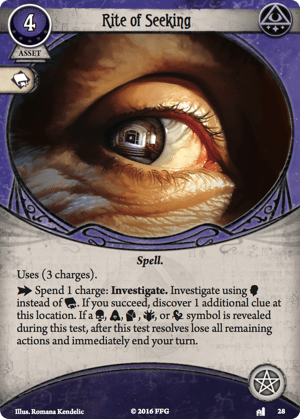
It’s a little baffling that Rite (0) wasn’t in the core, because it’s such a vital part of the clue mystic toolbox. It’s still a bit tricky to pull off—it’s just a stat swap, there are only three charges, and a bad-things symbol ends your turn—but it’s enough to stay relevant, even ten cycles into the game.
Interestingly, the extremely similar Fingerprint Kit doesn’t feel nearly as good to play. Both cost a bunch of cash, take a crowded slot, and offer somewhat limited tempo, with three uses apiece (four actions for six clues is hardly breaking a scenario) . . . and Fingerprint Kit has a stat boost, and no bad-stuff downside! All this to say: that stat swap really, really matters, and seekers get enough clue tempo in less-expensive ways.
Best in-class fits: Akachi, Dexter, Jacqueline
Any 5-willpower mystic interesting in clue-gathering is going to consider Rite. There are more options in a full card pool, including the nearly identical Clairvoyance suite (which came with Jacqueline and is probably a little better, honestly), but these three get an added benefit: Akachi ups the charges to four, Dexter gets action and resource bonuses from his asset mill, and Jacqueline can play around the bad stuff tokens with her power.
Is this ever better than Clairvoyance? . . . probably not, right?
Best out-class fits: Pete, Sefina, Patrice
The out-of-class investigators who get a boost of at least +2 for swapping intellect for willpower: Zoey, Mary, Sefina, Pete, Patrice. Of them, Zoey and Patrice feel the worst; it’s too expensive for Zoey to off-hand, or for Patrice to drop during the one turn it’s in her hand. Mary, at least, is probably playing support and can build into it; Sefina can afford it, too, even if it’s not optimal.
There’s an argument that Rite is best off-class in Pete, though, who can use Duke to bridge the non-Rite turns, and then combo the two. He’ll need another willpower buff to make it matter, but that isn’t too difficult in survivor.
Ritual Candles (Dunwich Legacy #29)
Brief: a sneaky good card that probably had a home even before curse decks became a thing
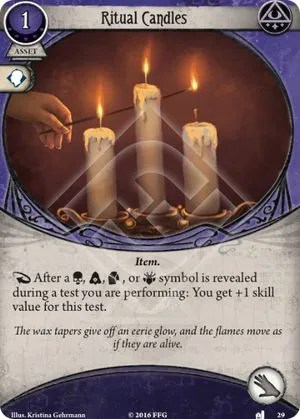
Listen, there aren’t many investigators who like bad-thing tokens, so at face value, Ritual Candles makes the bag slightly better for worst-case pulls. Which even for its pretty meagre cost, doesn’t feel great. But there’s one detail that really pushes this into value-add territory: it doesn’t exhaust on use, which means multiple bad-stuff pulls in a single test net multiple +1 boosts . . . or +2 boosts, for those running two.
And then curse decks happened, and now a pair of these can just fully negate the negative effects of every curse token drawn, giving mystics access to disgusting card powers for practically zero drawback. Well, for them. The rest of the team will have to deal.
Best in-class fits: Jim, Dexter, Jacqueline
Jacqueline’s ability makes it pretty easy to play around curses, and Ritual Candles did get a reprint in her set, so let’s slot her here. Dexter (who came out in Innsmouth; this makes sense) is probably a little more fun, and his ability makes it trivial to get these into play, but it does shut down the asset mill. While on the topic of curses: does Kohaku really like this? His Book of Living Myths takes a hand slot, but there is an argument to be made for him over Jacqueline, at least.
And then there’s Jim, for whom this card was originally printed. There’s this absolutely sick play with him, where every skull becomes a +2; it requires some decent token fishing and card draw, but is fun enough to build into. Let’s leave him here for old-time’s sake.
Best out-class fits: Pete, Mary, Zoey
This probably isn’t the best play, to be fair, but this does turn bless tokens into a +3. In a blurse team, that’s something; otherwise, well, testing that far down is straight folly. Let’s stick with the assumption the team is going full blurse, in which case, these three don’t mind the bonus.
Clarity of Mind (Dunwich #30)
Brief: a support card balanced around early-design healing, which didn’t hold up long term
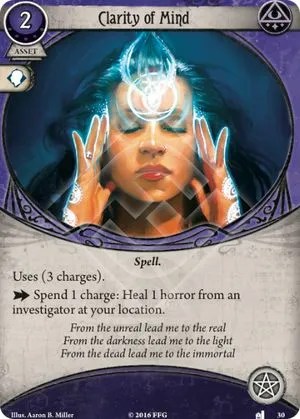
In smaller player counts, where every action matters a great deal more, Clarity of Mind is a non-starter. It’s just too action-intensive, effectively costing two resources and more than a full turn to negate a single bad Rotting Remains test. Bleh. In higher player counts, though—and in specific investigators—Clarity gets some value beyond “click to remove horror.” It’s especially important when an investigator is on the brink, where a single bad encounter card can simply kill them. Like Rotting Remains!
Best in-class fits: Jim, Dexter, Amina
Yeah, this is a weird group. Jim’s here as pure support, possibly in low-sanity teams that might rely on him for his trumpet. Which, for flavour? Go off. Dexter gets this out for free (and a single resource), which maybe makes it worthwhile for him?
And yet, there’s maybe a better case for Amina, who can play this for free in an emergency, doesn’t care as much about the arcane slot, and can kill it with any of the many “discard an asset” card abilities that she somewhat requires to function. Again, in a purely support role, a one-of in Amina wouldn’t be absurd.
Best out-class fits: Carolyn
This one is pretty obvious: Carolyn also adds a resource to the mix, is often playing support, doesn’t mind the arcane slot, and can use this to proc Hypnotic Therapy, which turns every charge into two points of horror healing. At that point, this is genuinely good.
Bind Monster (Dunwich Legacy, #31)
Brief: the non-Elite clause makes the XP, and resource cost, difficult to justify

Someone missed the memo that mystics are resource-starved, and accidentally green-lit Bind Monster and Hypnotic Gaze. The good: Bind Monster locks down (sort of) an annoying, non-Elite enemy. The bad: this effectively requires a non-Elite hunter enemy, or some kind of marvelous team synergy, to make any amount of sense. And a mystic with a willpower of at least five, because three resources and 2XP are not worth a single stat-swapped evade.
So, who wants to keep enemies around?
Use-case one: Luke and Trish
This isn’t terrible. It’s a bit awkward for non-Luke investigators, because it requires both characters to be at the same location, but if Luke is able to get his willpower a bit higher, he can effectively lock down an enemy at range for Trish . . . who can engage said enemy, and start dragging them around the map a la Handcuffs.
Which, Handcuffs (one extra action, no ongoing test) is just better, right? But Luke and Trish don’t have access to that, so for 2XP, here’s a more expensive and less reliable option. Cool.
Use-case two: Jacqueline and Alessandra
Just, don’t play this on Zamacona, who still accrues doom (unlike Handcuffs. God, Handcuffs is a really bad look for Bind Monster stans, eh). But other enemies? Alessandra usually needs them around to trigger her free action, and Jacqueline has the easiest time at baseline keeping them in check.
Alternate use-case: max testing decks
A sneaky bonus of Bind Monster: it triggers a test every turn, and while that isn’t ideal in most situations, there are card effects that trigger on token reveals. Jim’s trumpet is an obvious one (heal a horror on skull tokens); another is Nephthys, who, for those unfamiliar, boosts willpower and seals bless tokens on use, in order to deal test-less damage. Sister Mary can take both?

SURVIVOR
Fire Axe (Dunwich Legacy #32)
Brief: an archetype-enabling weapon that, even outside that archetype, goes pretty hard
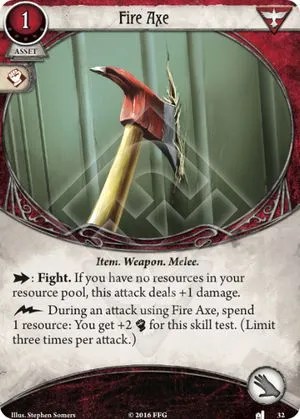
Survivor cards are so thematically fun. This one turns a regular investigator into an axe murderer, as long as they’re out of resources . . . and therefore, pretty desperate. It obvious pairs pretty clearly with Dark Horse (no resources = +1 to all stats) and Madame Labranche (no resources = 1 resource), allowing most investigators to turn this into repeated +2 combat, +1 damage attacks. Other cards that tap for resources include Forbidden Knowledge and David Renfield, making mystics with survivor off-class a totally valid play.
Best in-class fits: Calvin, Patrice, Silas
A lot of survivors don’t mind Fire Axe, honestly, but these three have interesting interactions. Silas, for instance, runs skill-heavy, so he doesn’t need the resources and can therefore float a pretty painless Dark Horse build, turning his combat into an effective 7 at least once a turn. Patrice is a bit weirder, starting at a base-2 combat, but she gets mystic access for those other resource boosters and can use her violin for an extra stat boost. It also helps her deal with her weakness, as a fun bonus.
Fightin’ Calvin is just a fun pick, with enough survivor shenanigans on top of his already silly investigator ability. Rise to the Occasion and a single resource puts base-Calvin at a combat 5, for instance. Do with that what you will.
Best out-class fits: Agnes, Zoey, Preston
Again, so many good options here (there’s a Dark Horse Minh build out there that takes this). In general, though: Forbidden Knowledge and Agnes super-charge this, allowing her to kill 3-health enemies with combat for a single point of sanity damage. Zoey is thematic, but also good, because her resource-generating ability effectively keeps her around a combat-6 (with this), for all intents and purposes.
I’ve seen this in Preston, too, which cleverly makes use of his Inheritance not actually putting resources in his pool, allowing him to swing for two damage with whatever boost makes sense, without actually slowing his resource play. Heck, it’s pretty thematic there, too.
Pete Sylvestre (Dunwich Legacy #33)
Brief: a long-time staple for a half-dozen reasons, and still pretty darned good
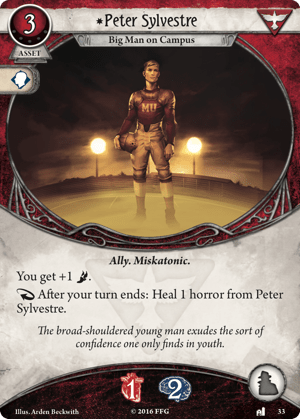
For a long while, survivor had a pretty limited selection of allies. Anyone running Dark Horse grabbed Madame Labranche; for everyone else, there was the Big Man on Campus, an unlimited horror soak that boosted agility, which was actually pretty big for early survivors. Like, there’s a real argument that survivor’s best pre-Dream Eaters ally outside Peter was Guiding Spirit (1).
Even as survivor moved away from agility tech, Pete remained pretty relevant—and it’s a bit strange to think of a card pool without him (for those opting for current, in the new environment). Is it actually a mistake? Dunwich was developed alongside the core, where most survivor cards are agility-oriented. Stray Car renaissance, maybe?
Best in-class fits: Calvin, Rita, Silas
As good as that agility boost is, BMOC’s value comes from his literally unlimited horror soak. Every round you take horror, he’ll negate one. Calvin especially likes that when he’s running a clue-focused build, because he can pretty reliably hang out at 5 horror with Peter in play. For Rita, this is somewhat win-more—but it turns pretty much all evasion-based skill cards into automatic triggers, and keeps her relatively fragile sanity pool stable.
Silas is interesting. He’d probably rather be killing enemies, and doesn’t especially need the stat boost . . . but there’s an argument that any 2-willpower, 5-sanity investigator who can take the Big Man probably should.
Best out-class fits: Agnes, Carolyn, Finn
This really comes down to ally options because, well, there are a lot of good ones in other classes (and way fewer reasons to soak sanity). Even the typical guardian tanks, Daniela and Tommy, have good reasons not to take Peter (he eats into Daniela’s soak, and Tommy would probably prefer disposable allies).
These three do, though. Agnes doesn’t get to proc her damage ability when horror is placed on Peter, but she does get some much-needed insurance once her sanity is depleted (this also gives her an evasion of 4, which is, like, totally fine in a pinch). Carolyn gets a resource every time Peter heals himself, which turns him into a bizarro Milan. And Finn doesn’t have many other ways to get an agility boost on a level-0 ally, so while this does cut into his splash, it’s probably worth it (the sanity healing on a 1-willpower investigator doesn’t hurt, either).
Bait and Switch (Dunwich #34)
Brief: a neat tech card that probably deserves more play than it seems
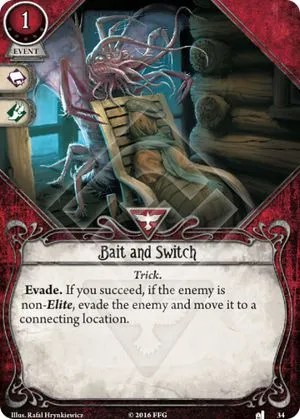
It’s early days, so we’re still getting a steady stream of evasion events in survivor. This one even has a pretty unique ability; it shuts down an enemy for two turns, effectively, exhausting them and shunting them to a connecting location (instead of the usual “the investigator gets a free move” effect). The issue might be that survivors weren’t very good at clue-finding for a long while, and this is optimal for investigators that want to clear a location of clues, but don’t necessarily have the time or space to do so.
Best in-class fits: Wendy, Rita, Stella
This is also lacking any sort of skill boost, so the ideal Bait and Switch investigator has some innate or skill-pumping way to hit the test—and as mentioned, a reason to stay put. Wendy has an easier time passing the test because it’s Wendy, she just passes tests, but she probably gets less out of the effect than the other two . . . who might actually be leaning into a clue-gathering play style, with cards like Belly of the Beast, Old Keyring, Matchbox, and Shed a Light.
Best out-class fits: Minh
Oh god, is there a Bait-and-Switch, Barricade play out there? There is, isn’t there? If so, it probably involves Minh spiking her agility with something like Inquiring Mind; there are other toolbox items for her too, like Seeking Answers and In The Know, if she wants to stay planted on a central location.
The really wild thing is, well, there isn’t another off-class investigator who can hope to reliably pass that evasion test, except Finn . . . who frankly, has better ways to use his splash. But this does count as a free evasion action.
Peter Sylvestre (2) (Dunwich Legacy #34)
Brief: a wildly good upgrade to an already great card
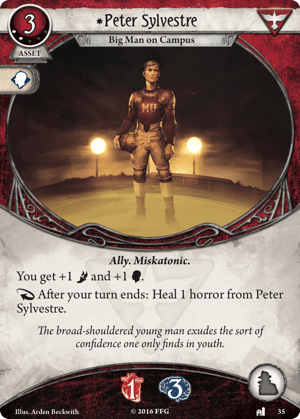
Why the upgraded Big Man (2) costs 2XP when virtually all double-stat-boost allies cost 3XP is unclear. What is clear: when an investigator takes this dude, the mythos deck gets a lot more chill. Horror becomes even more trivial. Bost defensive stats get a boost. An investigator can focus on what they do, and let Peter hold down the back end.
Best in-class fits: Pete, Rita, Hank
At this point, it’d be safe to list almost every survivor and call it a day. These three are more archetypical for the reasons to take Peter: Ashcan can actually lean into his willpower for mystic stuff, Rita gets exceptional horror protection, and Hank gets to tank endlessly for the team. On the subject of Hank: a paltry 9 XP allows for Charisma (3), two copies of BMOC (2), and two copies of Jessica Hyde (1). Damage and horror has never mattered less.
Best out-class fits: Agnes, Carolyn, Daniela
We can swap Finn for Daniela here, who loves the horror healing and can use this to effectively lean into her willpower. The others are obvious; Agnes even gets a boost to her willpower, which must have been why the developers kept Peter at 2XP. Thank goodness they didn’t gate any other obvious investigator synergy cards behind 2XP (pour one out for the Daisy-Book of Shadows (3) decks we never got).

NEUTRAL
Kukri (Dunwich Legacy #36)
Brief: an effect that makes more sense on paper than in gameplay

Neutral weapons should be below the curve. This one even reads okay; it’s mid-expensive, has a small stat boost, and is probably best for a flex investigator. The tempo loss is palpable, though; enemies almost always have 2+ health, so getting some kind of damage acceleration online is really important. This, and any combat skill card worth its salt, near-guarantees two damage for two actions, which just isn’t fast enough for anyone investing in combat assets.
What if there was an optimal situation for Kukri?
Optimal use-case #1: damage-boosting skill cards
Two actions for three damage is a lot closer to being effective. How many damage-boosting skill cards are out there? Vicious Blow is the obvious one, but Yorick (for instance) could run two copies of Strong-Armed (1), Brute Force (1), and Long Shot. Whether Yorick wants to run so many skills is debatable.
What about Mark? He gets access to half as many options, but gets a near-guaranteed three-damage shot with The Home Front. If Mark wants to use his second hand slot for an ammo-using weapon, this could actually make sense from time to time.
Optimal use-case #2: . . . enchanted Kukri?
How about this: once a turn, imbue Kukri with the ability to swing for two damage, with an optional bonus third point (as needed). If Zoey is running Enchant Weapon twice, there’s a genuine play where she attaches the second to her off-hand, which could be the relatively affordable Kukri. This is mostly about Enchant Weapon being incredible, but it’s still pretty incredible on Kukri.
Optimal use case #3: infinite-action rogues
Some investigators care more about their actions. Rogues have access to more, in general, making this a somewhat viable off-hand option for a Tony or Michael, who would sometimes prefer not wasting ammo from their main weapon. It’s also relatively cheap Crypt Chill fodder, or really, fodder for any asset-canceling encounter tech.
 Working a Hunch
Leave a comment